




The history of the Dominican Order in Japan can be divided into two periods.
Namely, the period of extraordinary missionary endeavor and martyrdom during
persecution times in the 17th Century (1602-1637) and a second modern period
of parish and educational missionary work starting from 1904 to the present.
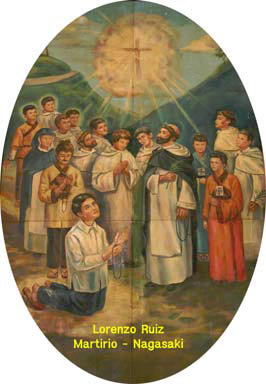
Shogun Oda Nobunaga (1573-1582) started trade with foreign countries, and He implemented a policy that favored Christianity. However, his successor, Toyotomi Hideyoshi (1582-1598), disagreed with this policy and in 1587 published an "Edict of Expulsion of All Missionaries." In 1597, due to disobedience to this edict, the first crucifixion of Christians occurred in Nagasaki.
In the midst of such persecutions and difficulties the need for priests was urgent. Accordingly, in 1601 Iehisa Shimazu, Landlord of the domain of Satsuma on the island of Kyushu invited the Spanish Dominican Missionaries to his feudal domain. The Dominicans of the Holy Rosary Province willingly accepted the dangerous call to come to help the needed persecuted Christians. In fact, Japan was the first mission the Province of the Most Holy Rosary accepted beyond the Philippines. And the best sign of their commitment is the fact that only one of the Dominicans who died in Japan during the 35 years (1602-1637) they carried out their missionary activity, died of natural causes, the rest (European and native Dominican Japanese) died martyrs.
In 1602 Fr. Francisco Morales OP arrived as Vicar with five companions and set up a religious house and built a church in Koshiki. Other brothers will soon follow, and together they preached from Koshiki throughout Kyodomari. Saga, Hamamachi and Kashima, all on the island of Kyushu. After being expelled from the feudal estate of Satsuma in 1609, they concentrated on settlements around Nagasaki and Omura. By 1609 there were Dominican Communities in Kyoto, Kyodomari and Nagasaki. Later Osaka was added. At first all went well. Many converts were made. Several vocations were tried and found suitable.
Later in 1614, Shogun Tokugawa Ieyasu (1603-1616), a fervent Buddhist who was very jealous of outside influences, promulgated "The Edict of Total Persecution" against Christianity. This edict was carried out with full rigor for 20 years and completely erased all public Christianity in Japan. Thereby, Dominican Missionaries were not able to spread out more widely. Slowly they were forced to go "underground." As political pressure and persecution increased, they organized the Confraternity of the Rosary and the Third Order, known today as Lay Dominicans, in all of Nagasaki and its environs. Since persecution intensified, these Japanese lay Christians did prodigious wonders of evangelization and in support of the missionaries. Many of them died for the faith, sometimes whole families gave their lives, thus writing one of the most beautiful chapters in the history of Japanese Christianity.
The succeeding Shoguns, Tokugawa Hidetada (1616-1623) and Tokugawa lemitsu (1623-1651) intensified the persecution against Christians who were killed by the thousands.
The causes of this terrible persecution were many and complicated, according to historians among the most important causes are the following : the anti-Christian attitude of the powerful Buddhists; the intrigues by and quarrels with foreign powers; the deceitful and underhanded campaigns by Protestants against Catholics; certain imprudent acts of foreign navigators; and the fear of the Shoguns of being dominated by foreign nations by means of religious influence during a critical period of unification of the country.
Of course, all of this political turmoil detracts nothing from the witness of our martyrs. They died in defense of the faith. In the year 1617, four European religious were executed and among them was Blessed Alfonso de Navarrete. The persecution spread throughout the country, even though it was concentrated in the Island of Kyushu, and was most furious and bloody in Nagasaki. In August and September of 1622, two spectacular martyrdoms took place in Nagasaki.
The second (September 10) is called the "Great Martyrdom." During this one, many of our Dominicans lost their lives.
There were many martyrs whose deaths were frightful. Crucifixions, beheading, and slow burnings were accompanied by other tortures even more refined. One such was known as "regurgitated water," which means that the victims were forced to drink great quantities of water and then their abdomens were beaten with great violence which forced the water out from the mouth. The brutal striking of the abdomen naturally caused internal organs to rupture and caused terrible hemorrhages and gripping pain. There was also the sticking of needles and sharp pieces of slivered cane under the nails and into other parts of the body. Finally, there was a torture called "gallows and hole." In this torment the persons were hung upside down from a gallows with the upper half of the bodies hanging into a fetid hole. The hole was then tightly enclosed with boards like a trap around the waist. Sometimes a gash was made on the head to extend the length of time it took to suffocate. At times it took days for them to die. Such were the ways by which many of our martyrs perished witnessing their faith.
In 1637, with the martyrdom of the last group of missionaries, the Dominican presence in Japan in the 17th century ended. The country was completely sealed off from the exterior world in 1640 and was not reopened until 1854.
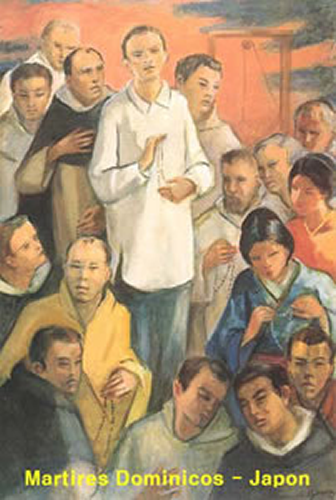
Thousands gave their lives for their faith, among them there were many Dominican brothers, sisters, Tertiaries (Lay Dominicans) and members of the Cofraternity of the Rosary. The following is a list of some well known Dominican Martyrs "Witnesses of the Faith" in Japan :
1. Alfonso de Navarrete. Beatified
2. Juán Martínez de Santo Domingo. Beatified
3. Luis Flores. Beatified
4. Francisco Morales. Beatified
5. Angel Ferrer Orsucci. Beatified
6. Alonso de Mena. Beatified
7. Jacinto Orfanell. Beatified
8. José de S. Jacinto "Salvanés". Beatified
9. Domingo del Rosario. Beatified
10. Tomás del Rosario. Beatified
11. Tomás de Zumárraga. Beatified
12 Mancio de Santo Tomás. Beatified
13. Domingo de Hyuga Beatified
14. Pedro Vázquez. Beatified
15. Luis Beltrán Exarch. Beatified
16. Pedro de Santa María. Beatified
17. Mancio de la Cruz. Beatified
18. Domingo Castellet. Beatified
19. Tomás de San Jacinto. Beatified
20. Antonio de Santo Domingo. Beatified
21. Domingo Ibáñez de Erquicia. Canonized
22. Francisco Shoyemon. Canonized
23. Jacobo Kyusei de Santa María. Canonized
24. Miguel Kurobioye. Canonized
25. Lucas del Espíritu Santo. Canonized
26. Mateo Kohioye del Rosario. Canonized
27. Magdalena de Nagasaki. Canonized
28. Marina de Omura. Canonized
29. Tomás Hioji de San Jacinto. Canonized
30. Jordán de San Esteban. Canonized
31. Antonio González. Canonized
32. Guillermo Courtet. Canonized
33. Miguel de Aozaraza. Canonized
34. Vicente Shiwozuka de la Cruz. Canonized
35. Lorenzo Ruiz. Canonized
36. Lázaro de Kyoto. Canonized
37. Jerónimo Yagozayemon. Not beatified
38. Juan Mozayemon. Not beatified
39. Domingo Kakusuke. Not beatified
For further study on this period of our history you can read the following book :
日本の聖ドミニコ: ロザリオの 聖母管区の 歴史 : (1581年-1637年).
正·佐久間, Diego Aduarte, Jose Delgado Garcia, 弥生·安藤
Ed. Katorikku Sei-dominiko-kai, Rozario no Seibo Kanku, 1990. 519 pages
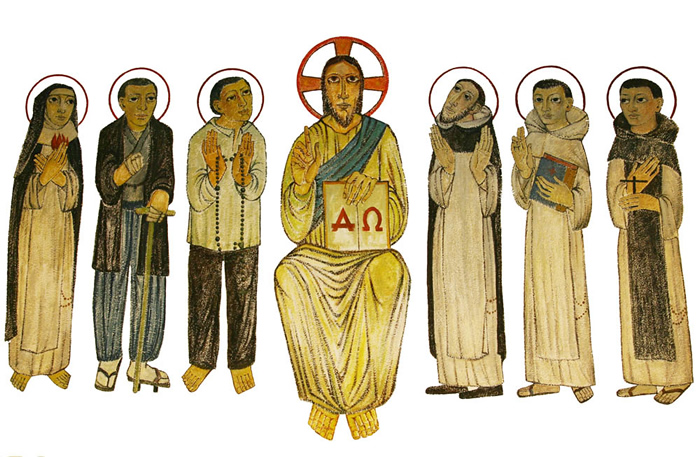
Dominicans of the Province of the Rosary returned to Japan in 1904, opening a second stage of Dominican evangelization in the islands which has continued until the present time.
In 1904 the Dominicans came back to Japan to work on Shikoku Island, constituted as an Apostolic Prefecture (27.1.1904). The Provincial named Fr. José María Alvarez as Vicar of the Province of Shikoku and on August 16th, 1904 he came to Kochi, and there in October 1904, He was named the first Apostolic Prefect of Shikoku. On October 18th, four Dominican missionaries joined him at the Kochi City parish (Tomás de la Hoz, Faustino Rodríguez, Millán Domínguez y Celestino Arbás). Together they began their apostolate of the island from Kochi and nearby cities.
Later during the Canonical Visitiations of Fr. Provincial in 1912 and 1913, Fr. Buenaventura García de Paredes ordered to build new houses and missionary centers separated and exempted from the authority of the Apostolic Prefect, so that the brothers could with more independence reorganized their own vicariate in order to improve their missionary work.
In 1949 the Holy See divided the Shikoku Apostolic Prefecture into four Ecclesiastical Districts(areas). Accordingly, the Holy See entrusted to our Vicariate of St. Joseph the territory of the civil province of Ehime, and since then all our missionary efforts have been centered on this territory. New parish churches and kindergartens were built and regarding to education it is worthy to mention the efforts by the Dominican missionaries in Ehime District. The brothers founded a first class Middle-High School, Aiko School in Matusuyama city (1952), and helped the Congregation of Missionary sisters of St. Dominic (a Sisters Dominican Congregation founded by the Province to help them in their missionary works) to found St. Catherine High School in Matsuyama city and St. Catherine's University in Hojo.
During the whole 20th Century of zealous missionary work, the help of our Dominican Vicariate of St. Joseph to the founding of the Local Church has been very important. The Dominican missionaries have not only converted many people to the Catholic Faith, They have also contributed generously to the developing of the new Diocese of Takamatsu, created by the Holy See in 1963 for the territory of Shikoku. The Dominican Fathers generously donated the property of the Churches built by them, as well as the lands around them to the Diocese. They only retained the property of their central house in Matsuyama. Still, they continue working on some of them, according to the available manpower and free of charge. They also continue with their own educational apostolic works in kindergartens and Aiko School.
As a summary of the fruit of their missionary endeavors and contribution to the foundation of the Church in Japan during the 20th century by the brothers of the Dominican Vicariate of St. Joseph, the following institutions can be named, among others :
A. Parishes :
1.- Churches taken over and further developed by the Dominican Missionaries :
Kochi (1904-1949), Tokushima (1905-1949), Uwajima (from 1906), Takamatsu
(1918-1949), Yawatahama (from 1937), etc.
2.- Churches founded and developed by the Dominican Missionaries : Akaoka (1933-1950), Awa-Ikeda (1933-1938), Shinhonmachi (Enoguchi-Kochi) (1937-1949), San Bancho (Matsuyama) (from 1905), Imabari (from 1926), Niihama (1937-2012), Saijo (from 1949), Iyo-shi (from 1953), Dogo (Matsuyama) (from 1957), Hojo (1968-), etc.
B. Kindergartens(At the present):
"Umi no Hoshi” (Matsuyama), "Seibo” (Dogo-Matsuyama ), "Tenshi” (Gunchu),
"Wakaba” (Imabari), "Maria” (Saijo), "Aiko” (Niihama), "Aiwa” (Uwajima),
"Seibo” (Yawatahama), etc.
C. Schools and University Residencies:
Aiko School in Matsuyama (1952); House of Studies in Kyoto (1951-1955)
together with the Canadian Province; Dominican House and Students’ Residence
in Tokyo (1959-2010) and Professors' Residence House in Nishinomiya (1989).
D. Establishment of the Dominican Order in Japan:
1. Our Dominican Missionary priests have also promoted and formed Japanese
vocations in order to establish the Dominican Order in Japan. However, given
the small number of Catholics, Japan remains a pure mission country, and our
Japanese Dominicans are few. Still, we continue openly to receive and form any
vocation.
2. They have also established in Japan the Confraternity of the Rosary and the Dominican Laity or the Third Order of St. Dominic, as it used to be called.
3. The Missionary Province of the Holy Rosary established in 1859 the Dominican Missionary Sisters of St. Dominic in order to help them in their missionary work in Asia. In Japan also during the twentieth century, our brothers established, promoted and directed the Congregation. Nowadays the Sisters work independently in a number of kindergartens and schools around the country, enjoying always a very good relationship with the Dominican Friars.
4. Our brothers also have helped the Dominican Vicariate of Canada, whenever cooperation or help was requested. For example: some of our brothers also have helped for several years as parish priests in the parish of the Canadian Vicariate in Tokyo. Our vicariate sent also novices and personnel to the Novitiate House in Tokyo in order to have a formation process in common. Unfortunately, such a project had to be discontinued for the lack of Japanese vocations.
E. Social Works:
From the beginning of our Vicariate, especially during the painful times after the
war, our vicariate created, in some of our houses and parishes, a way to help
the poor by distributing food and clothes.
The vicariate also built in 1954 the major Psychiatric hospital of Matsuyama as a social service. The vicariate ran it for 5 years only, until it was taken over by the doctors.
Since nowadays the Japanese government has taken over most of the social needs of the people, still keeping the help of the few poor people who call to our doors, especially in our parishes in Japan, we have extended our help to people abroad, helping projects like St. Martin de Porres Charity Hospital in San Juan city (Philippines).

Copyright (C) dominico. All Rights Reserved.
